
The business payment layer for stablecoin settlement.
Stablecoin B2B payments are compounding, but the tooling is either a checkout button or a heavyweight AP suite. Bliz owns the middle: the invoice → pay → reconcile → fee-statement loop, settled non-custodially in stablecoins. Receivables first; commerce, POS, and platform API reuse the same primitive.
The opportunity
The wind is at the category's back—and the unserved middle is the business-object layer the platform giants ignore.
A market validating in real time
Stablecoin payment volume reached roughly $390B in 2025 (about 2× over 2024), with B2B now around 60% of it and growing 733% year over year. Stripe (Bridge), Coinbase, and Circle are validating the category—the question isn't whether this is a market.
MiCA created an EU moat
Under MiCA, USDC and EURC are the compliant euro-region stablecoins. "We settle you in MiCA-compliant stablecoins, EU-native, with VAT and tax-ID first-class" is a credibility line US-first players can't say as cleanly—a structural advantage for EU receivables.
Cross-border pain is acute
A wire runs €20–50 plus a 2–4% FX spread and 1–5 day settlement; remittance averages above 6%. Bliz is cross-border by construction—a payer anywhere settles straight to the merchant's wallet, no correspondent banking. The incumbent to beat is the wire, not domestic SEPA.
The empty quadrant
Crypto checkout buttons stop at the payment. Heavyweight crypto-AP suites are built—and priced—for funded crypto-cos. Infra/API players sell rails, not a merchant-facing receivables product. Nobody owns the invoice → pay → reconcile → fee-statement loop for the EU SMB. Bliz sits at the intersection of four properties no competitor holds together:
- Non-custodial — funds settle to the merchant's own wallet; Bliz never takes custody.
- Receivables-shaped — built around the invoice and the full reconcile → fee-statement loop, not a checkout button.
- EU-native — VAT, tax-ID, MiCA-compliant stablecoins, SEPA-bridged fee collection.
- SMB-priced — per-payment, capped per invoice; no $7k/yr AP-suite contract.
Wedge first, platform next
The defensible wedge is the business object, not the rail. One primitive—the Payment Request—proves itself in Receivables, then the same primitive composes into the next surfaces. Invoice, link, checkout, API, and POS are skins on one object.
Market figures are third-party data (e.g. McKinsey on 2025 stablecoin payment volume; provider-stated headline rates), cited for context—not Bliz metrics. Single figures carry normal estimate drift; verify against live sources before relying on them.
The product — built and running on testnet
The full loop works today: a merchant invoices a client, the client pays a hosted link, it settles non-custodially to the merchant's wallet, and every payment produces a receipt, a reconciliation record, and a monthly fee statement. Shown below on testnet, with first design partners onboarding.
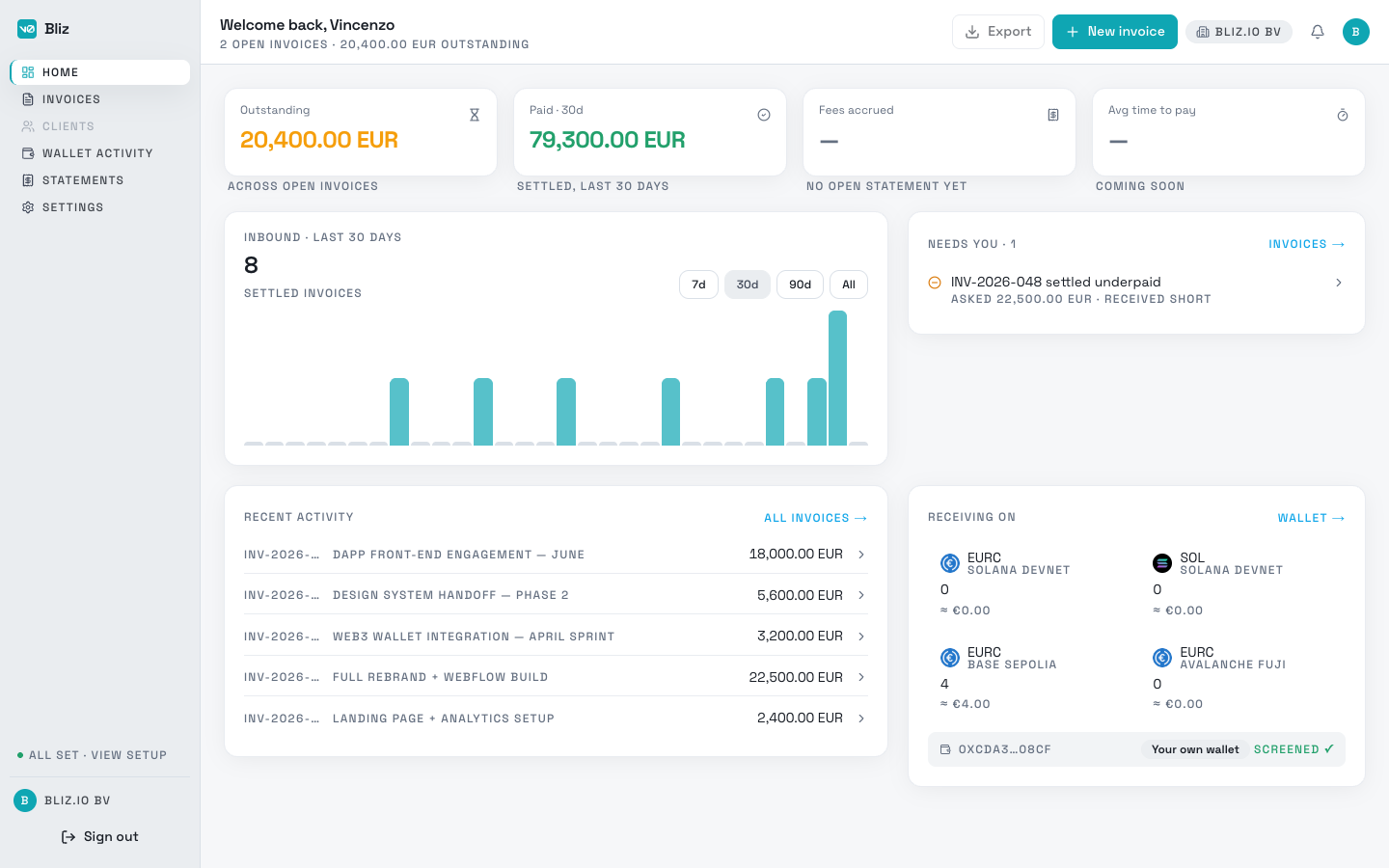
1. The merchant's receivables, at a glance
Outstanding receivables, settled totals, accrued fees, and live wallet balances—the payment side becomes finance-ready in one view. The merchant creates a VAT-clean invoice and sends a hosted pay-link.
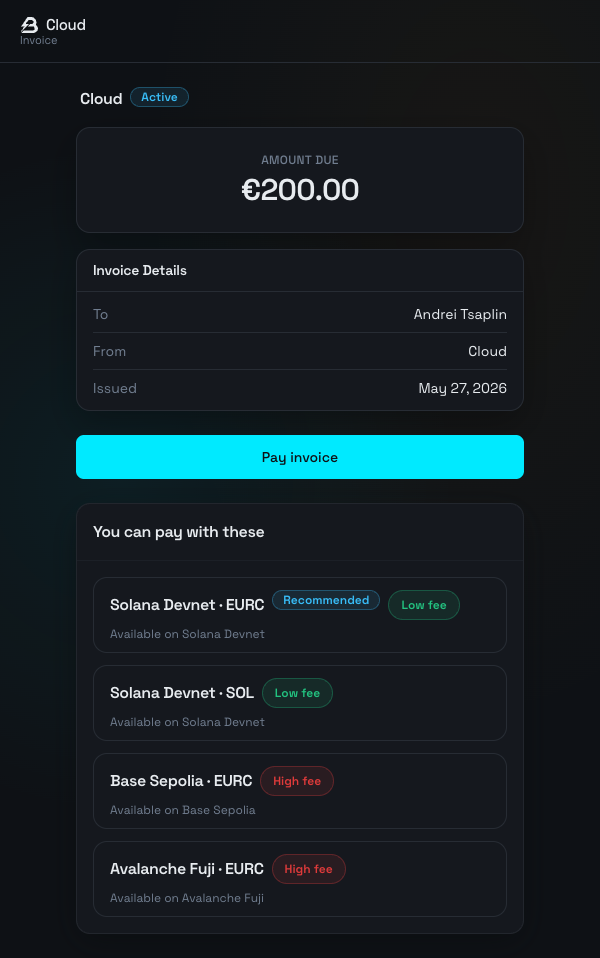
2. The client pays a link
A hosted pay-link from anywhere in the world. The client sees the invoice, Bliz recommends the lowest-fee rail with a one-line reason, and they confirm—a single clean step.
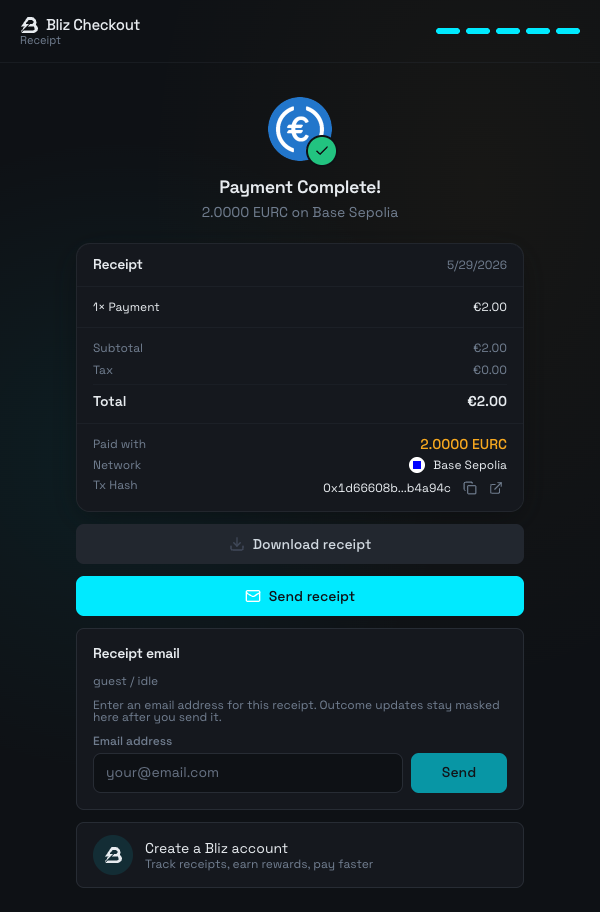
3. It settles, with a filable receipt
Funds settle directly to the merchant's wallet—Bliz never takes custody. The client gets an on-chain receipt with the transaction hash and an itemized total their treasury can file.
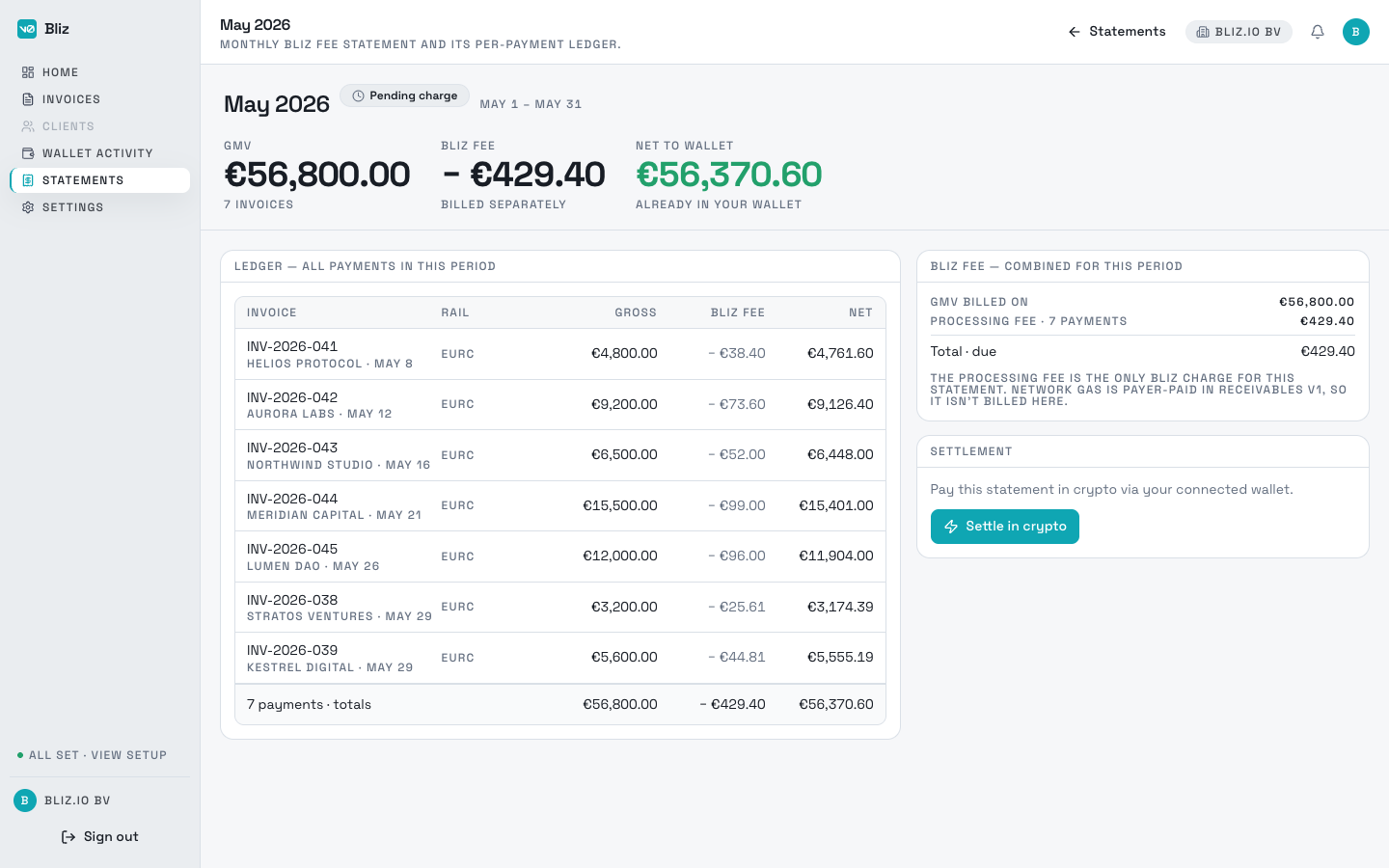
4. Reconciliation & the fee-statement spine
A per-payment ledger of rail, fee, and FX for the accountant—plus a monthly fee statement the merchant settles in crypto. This non-custodial collection spine is how Bliz monetizes: fees are receivables, statements are non-optional.
Investor Questions
Design-partner stage and pre-revenue. The full receivables loop—invoice, hosted pay-link, non-custodial settlement, on-chain receipt, reconciliation, and monthly fee statement—is built and working on testnet, and we're onboarding our first design partners now. We are not yet processing live mainnet volume, and we make no claims of GMV, users, or revenue at this stage.